Vulnerable to Hackers and Errors
Page uses Atkinson Hyperlegible font from Braille Institute
The wide-ranging examples here show that hacks and
software errors in elections can be reduced but not prevented. The only
protection is to detect errors and
recover, which means independently checking the counts. Reputable software
has hundreds of bugs, and annual updates have bugs. Chinese, Russians, other countries, and organized crime have infiltrated everywhere worth infiltrating. The SolarWinds hack is one
of many similar (as yet undiscovered) infestations which affect all organizations. Policy makers need a broader, longer term view than software designers. Election
offices & companies need physical tokens, not
passwords.
Contents
of This Page
B. Election
Vulnerabilities, With Unknown Results
C. Air-gapped,
Offline Computers
E. Future
Hacks
A.
ELECTION MACHINE ERRORS
B. ELECTION VULNERABILITIES, WITH UNKNOWN RESULTS
1. 2026 Drivers
licenses for 152 million Americans were being sold online, apparently from
an ID verification service used by Hertz and others.
2. 2026 CISA summarized
Biden-era findings about election offices, “In multiple cases, CISA assessors
gained full network control within hours or days, demonstrating that many SLTT
[state, local, tribal and territorial governments] partners remain soft targets
incapable of stopping even moderately skilled adversaries.” www.documentcloud.org/documents/28493623-cisa-election-report-2026-7-13/
3. 2023 Dominion executives recognize “our shit is just riddled with bugs... we
don’t address our weaknesses effectively!” Besides bugs, they know they need
more failsafes, for example that Dominion software
should have been designed to catch the miscounts in Antrim MI. (pp.15-16, or 25-26 in pdf)
4.
2022 China aggressively targeted Canadian federal
elections, with secret money for 19 candidates, some of whom knew it, and
placing staff. Goal is to change Parliamentary votes on China. Do they do the
same in other countries?
5.
2022 Increase of thousands of phishing emails
detected for election workers before primaries in AZ & PA. If other states
were targeted, it was not detected.
6.
2015-2022 Iran targets US elections
7.
2022 tests found that 30% of workers fall for phishing attacks in technology
companies (election vendors would be in this category), and 25% in government..
These dropped to 5% after a year of regular anti-phishing training and monthly
simulated phishes, so companies or governments with hundreds of workers stay
very vulnerable.
8.
On 6/3/2022, CISA warned states about several
vulnerabilities in Dominion ballot marking devices.
9.
On 11/4/2020, before any state had audited
election results, CISA and other federal agencies assured voters that "Robust safeguards including
canvassing and auditing procedures help ensure the accuracy of official
election results." And 11/12/2020 they said "The November 3rd
election was the most secure in American
history" still before audits were done. These
were the same federal officials who had not noticed their own systems had been
infiltrated by Russian hackers for 8 months. Yet they were sure all 15,000 election jurisdictions
were secure. Commentary narrowed their claims.
10. As of 2019, researchers have found security flaws in all election
computers, which let voters, staff members or outsiders disrupt or change
results, often without detection.
11. Through 2019, Russia has spent billions of dollars on a decade of work
to create broad-based new ways to attack
election computers (zero days), using independent teams so they don't reveal
each other's methods.
12. In 2018 the Election Assistance Commission
denigrated cyberthreats and declined to provide cybersecurity guidance to local
election offices.
13. In July 2018 the FBI told Maryland officials
that a local web hosting company they used for voter registration, candidacy, online
ballot delivery, and election results had been owned since 2015 (or 2011) by a company financed by Vladimir Potanin, a
Russian oligarch close to Putin. The manager is a Russian millionaire, Guerman Aliev, who took an American name, Gerald T. Banks.
Maryland's Senate President said the FBI "weren't really anxious for us to come forward" to tell the public (quote is at 6:54 in video). FBI also told
state officials in 2017 not to tell the public about foreign intrusion attempts
(pages 146-151 of court filing).
14. In March 2018 the security site CSO found on the dark web over 100 emails
of workers at one of the largest companies making and programming election
machines, ES&S, and smaller numbers at smaller voting machine companies.
They also found passwords for the accounts, though the companies said these
passwords did not meet their current standards, so would have been changed.
Nevertheless with valid emails, attackers can spray password variations until they
log in on at least one of the accounts and
install malware. Hackers share tips on the
dark web.
15. In October 2017 Senator Wyden asked voting machine manufacturers about their
security practices. Results were not encouraging. Letters from Dominion, ES&S, 5Cedars, Unisyn
16. From August 2017 to March 2018 Georgia's election software was on the
public web without passwords or encryption (pages 140-143, 153-163 of court
filing, news).
17. In August 2017 the biggest manufacturer of voting machines, Election Systems & Software,
created a public file on Amazon Web Services with "encrypted versions of passwords for ES&S employee accounts. The encryption was strong enough to keep out a casual hacker but by
no means impenetrable...The worse-case scenario is that they could be
completely infiltrated right now".
18. In May 2019 the FBI told Florida officials 2 counties' voter
registration systems had been penetrated by Russia in 2016. The FBI could not say if the
Russians changed the files, and only revealed anything because the Mueller
Report did. The counties were Washington and one
other.
19. In 2016, "We can assume that the majority of states were probably
a target... I want to make clear today on the record, it's likely that all 50
states were likely affected... Every organization is scanned a lot, sometimes
thousands of times a day. What we were trying to differentiate between: we saw
very concerning activity from known suspicious servers in this case... They
were targeting to look for vulnerabilities... Probably tried all the states.
These are the states we could see they were trying. That's right." ~US Department of Homeland Security Senate hearing at 41 minutes.
20. They attacked "in alphabetical order by state name... voter
registration and election results sites... to identify and exploit SQL database
vulnerabilities in webservers and databases. The FBI and DHS... noted
that they had no information on how many of those attempts were successful,
aside from two instances"
21. August 24, 2016, hackers sent phishing emails to seven workers at VR Systems, which provides voter
registration systems and election-night reporting. "At least one of the employee accounts was likely compromised." Then on October 27 they used VR Systems credentials to send
phishing emails to 122 local election officials. If they opened it, it
installed malware which opened a persistent back door into the computer. At
least 10 computers were harmed
(¶77b). The government has not said and may not know what the hackers did with
their back door. Mueller's indictment July 13, 2018 confirms these events
(¶73-77) and adds that the hackers targeted more than one election company
(¶69). 2 years after the election, the press revealed that VR Systems had a
common practice of remotely accessing county
election systems, to troubleshoot them, up to the day before the election.
22. Also in 2016 hackers sent emails pretending to be from another election vendor, offering
"election-related products and services." The same hackers sent
emails to election workers in American Samoa "mimicking a legitimate absentee ballot-related service provider."
NSA does not know what they
accomplished with any of these attacks.
23. In 2016 Georgia, Indiana and Idaho said the
US Dept. of Homeland Security tried to bypass firewalls in election systems
without permission. Kentucky and West Virginia said DHS probes of their systems were not malicious.
24. Ukraine's 2014 election
results were hacked, but officials removed a virus and believe they had correct
totals. South Africa's 1994
election was hacked, and officials hand-compiled the counts, as noted at right.
25. A 2007 study for the Ohio Secretary of State reported on election
software from ES&S, Premier and Hart. Besides specific problems it found,
it noted that all "election systems rely heavily on third party software that
implement interfaces to the operating systems, local databases, and devices
such as optical scanners... the construction and features of this software is
unknown, and may contain undisclosed vulnerabilities such trojan horses or
other malware."
C. AIR
GAPPED, OFFLINE COMPUTERS
1.
2024 Russian worm spreads by USB drives beyond its first target of Ukraine
2.
2022 Satellite communications closed down during Russian invasion of Ukraine
3.
2022 NATO classified documents stolen from Portugal
4.
2022 Detect vibrations with a smart phone gyroscope
5.
2020There is
standardized malware to enter air gapped computers, by hiding in files on thumb
drives, in case the drive is later taken to an air-gapped computer, such as updates
for voting machines. It was developed by hackers who are believed to work for
South Korea.
6. 2017 air gapped computers
in CIA. Investigation has
found circumstantial evidence and a mistrial, so punishment for the leaker(s) is not assured.
7. NSA air gapped computers
in 2016, followup
in 2017
8. Electric grid air
gapped computers hacked in 2014, 2016-2018 (and US
in 2012-2019 Russian
and Iranian grids)
9. CIA in 2011-15 had "A major concern... that the Russians were
collecting information from a breach of computers not connected to the Internet... The CIA had already figured out how to perform similar operations
themselves."
D.
BEST-DEFENDED INDUSTRIES
This list shows that companies' computers will never be bug-proof
or hack-proof, since problems happen at even the best-defended industries.
Hacks and bugs can be reduced but not prevented. The only protection is to detect errors and recover, which means
independently checking election tallies.
1.
2026
Iran hacking water systems
2.
2005-2026
Fast16 altered math calculations, probably to undermine Iran & North Korea
nuclear programs, before Stuxnet
3.
2013-2026
Windows & Linux can be duped into accepting false firmware.
4.
2025 MS Sharepoint flaw let hackers into 400 systems, “federal and state
agencies, universities, and energy companies”
5.
2024 5 Eyes list the 15 vulnerabilities
used most often to breach systems. NIST lists 98 security
vulnerabilities in making hardware chips
6.
2024 Average
companies have 6 errors in configuring encryption for transferring data, 4.1 High
or Critical vulnerabilities (levels 7-10) from unpatched software, 2.8 email
security flaws, 1.7 services online which should not be. 12% of ransomware
events are in local government. Ransomware victims after a year have 56% more
services online which should not be.
7.
2024 “XZ Utils”
is an example of a pervasive utility, managed by one person, being subverted
8.
2024 FBI &
CISA, seeking more budget, say China has widespread access in US critical
infrastructure, and 50 times as many “cyber operatives” as total FBI agents.
"Chinese cyber actors have taken advantage of very basic flaws in our
technology. We have made it easy on them,” said Easterly, head of CISA.
“Unfortunately, the technology underpinning our critical infrastructure is
inherently insecure because of decades of software developers not being held
liable for defective technology." The hackers are believed to be deeply
entrenched in US infrastructure.
9.
2021-2031 Ubiquitous Log4j will allow attacks
on computers for a decade. China requires its companies to disclose
vulnerabilities to the Chinese government when found, before they're fixed.
10. 2009-2024
Most Windows or Linux computers (including election computers) parse a logo to
display before installing the operating system. Hijacking the parser lets
attackers overcome most later security checks.
11. 2023 top 10 weaknesses in cloud computing (pdf)
12. 2013-2023
timeline of Experian flaws which make credit histories available to attackers
13. 2013-2023 timeline of N.
Korea attacks
14. 2018-2023 “any company that
hired freelance IT workers over the last few years ‘more than likely’ hired
someone” from North Korea, pretending to be American. "In
some instances, the North Korean workers also infiltrated computer networks and
stole information from the companies that hired them, the Justice Department said.
They also maintained access for future hacking and extortion schemes... "program has been in play for more than a decade ,
but the effort got a boost from the COVID-19 pandemic."
15. 2023 Some Android systems
in TVs and tablets come with backdoor for malware pre-installed
16. 2019-2023 Millions of mail
servers vulnerable through EXIM software, and company has not prepared a patch.
17. 1999-2023 “RSA, Other
Crypto Systems Vulnerable to Side-Channel Attack” in bad implementations, which
are still common in 2023. Full paper.
18. 2020-2023 Microsoft exposed
38 terabytes of their private files with read/write access, by misconfiguring a
token given to the public
19. 2023 China hacked thousands
of computers through a weakness in Microsoft security. Russia also hacked
Microsoft, with less clear results. Hack included US Commerce
Secretary, Ambassador to China, Assistant Sec. of State and others’
emails on diplomatic
strategy
20. 2020-2023 China deeply
penetrated Japanese military networks
21. 2023 UK Electoral Commision revealed hacker had access to their emails and
the UK voter registration system from August 2021 to October 2022
22. 2023 Fleets of
computers in data centers can be hacked remotely through a vulnerability in the
code which lets administrators update
multiple computers.
23. 2023 Secure radio
controls for pipelines, water & other critical infrastructure have had a backdoor
since the 1990s. The firmware was secret, so not checked until Dutch
researchers reverse-engineered it in 2021. The firmware has been replaced in
new radios with other secret codes, not yet checked by outsiders. These radios
are used throughout the world, though not commonly in the US
24. 2023 MSI (which makes motherboards
and computers) leaked its signing key, so hackers can send updates with back
doors and other malware
25. 2023 Microsoft will
take a year to fix a severe security bug in booting up its computers, because
correcting it makes old boot media fail.
26. 2023 Motherboards from
Gigabyte, used in high performance computers have backdoor installed by maker
in the firmware which loads the operating system, so it is hard to see or
remove
27. 2023 US no-fly list is
distributed to many airlines, and leaked from one of them
28. 2021-2022 Lapsus$ group of teenagers
hacked major tech companies by phishing, bribing insiders, calling contracted
help desks, buying access from black market “Initial Access Brokers”,
pretending to be law enforcement with “Emergency Disclosure Requests,” and other human contacts. It advertised for insiders at
tech companies. “The cyberattacks were not the work of a nation-state actor, nor
did they always involve particularly complex or advanced tooling or methods.
Yet the attacks were consistently effective against some of the most
well-resourced and well-defended companies in the world... exploited the
tendency for enterprises and their employees to document internal procedures,
share information on collaboration platforms, and use ticketing systems to
perform internal help desk operations... 34% of surveyed respondents believed their
third-party suppliers would report a breach to them. Over 50% experienced a
breach that originated from one of their third-party suppliers within the last
12 months,” Phone retail store staff are low-paid, lightly trained, with
privileged access. APT-Advanced
Persistent Teenagers
29. 2022 Ponemon survey found
63% of IT professionals said their organization had been breached and sensitive
or confidential information misused. Only 36% evaluated security & privacy
of contractors. Only 12% were very confident a third party would tell them if
the third party was breached.
30. 2022 GAO said about information
security programs, that “Inspectors
General reported ineffective programs at 16 of 23 civilian agencies. Our
recent reports also identified major weaknesses in government-wide and
agency-specific cybersecurity initiatives”
31. 2022 Hack of Sargent
& Lundy engineering firm, which has designs of electric utilities and is
subject to looser cyber standards than the electric utilities
32. 2022 CISA recommends phishing-resistant
multi-factor authentication, but important to know how it can still be phished
or hacked
33. 2022 Apple only
maintains full security fixes on latest versions of operating system, though
saying others are "supported".
34. 2022 Microsoft Defender
lets through 19% of phishing emails
35. 2007-2022 Python bug
present in 350,000 projects
36. 2022 Subscription for
criminals to bypass multi-factor authentication, by capturing the session cookies
which prove authentication, so criminals can continue to access the victims'
accounts, $400/month
37. 2022 5G networks are
hackable
38. 2022 intruders gained
access to Cisco, by phishing an employee, intending to sell access
39. 2022 China runs "a
coordinated campaign on a grand scale... Seeking to bend our economy, our
society, our attitudes to suit the Chinese Communist Party’s interests... the
Chinese Communist Party is interested in our democratic, media and legal
systems. Not to emulate them, sadly, but to use them for its gain... But the
right model can’t be to scale the operational agencies to somehow take on all
of this activity."
40. 2022 Homeland Security
staff have been charged with helping China.
41. 2022 Organizations
which discover they've been hacked don't improve defenses enough to avoid
future hacks.
42. 2022 "Managed Service
Providers This advisory defines MSPs as entities that deliver, operate, or
manage ICT services and functions for their customers via a contractual
arrangement, such as a service level agreement... Offerings may include
platform, software, and IT infrastructure services; business process and
support functions; and cybersecurity services... U.S. cybersecurity authorities expect
malicious cyber actors—including state-sponsored advanced persistent threat (APT)
groups—to step up their targeting of MSPs in their efforts to exploit
provider-customer network trust relationships."
43. 2022 Malware
"offline and online delivery technique" is for sale for $69/month or
$249 lifetime use.
44. 2022 Defense staff
& contractors need card reader at home to use secure systems. Common reader
has malware.
45. 2022 storage from SanDisk, Sony,
Lexar, and probably others has a flawed, breakable file encryption system.
46. 2022 Defense
Department still uses Chinese telecom & security equipment declared
insecure 3 years before. So do corporate jets and rural cell phone towers
(needed by election workers). Chinese companies are ending support in the US.
DOD use includes web-connected security cameras.
47. 2019-2022
Ragnar Locker ransomware infected "at least 52 entities ... in the
critical manufacturing, energy, financial services, government, and information
technology sectors,"
48. 2022 China has
been using a hacking tool unnoticed for 10 years
49. 2022 NSA used a
set of hacking tools for 10 years in 45 countries, primarily China, Japan,
Korea, Germany, Spain, India, Russia, Mexico and Italy.
50. 2022 DHS &
Commerce report said, "The ubiquitous use of open-source software can
threaten the security of the software supply chain given its vulnerability to
exploitation... outsource firmware development to third party suppliers, which
introduces risks related to the lack of transparency into suppliers’
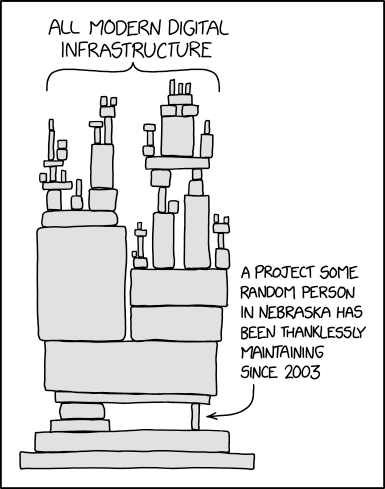
programming and cybersecurity standards." (Cartoon which they didn't cite). Developers can set the code to attack certain
computers
51. 2022 75% of US
defense contractors fail government standards
52. 2021 58-80 vulnerabilities
exploited in the wild before manufacturers knew of them (zero-days). In 2020
there had only been 25-30. "For all types of actors, a lot of
bread-and-butter hacking still involves exploiting vulnerabilities that became
public long ago but haven't been patched consistently. Zero-days are still less
common. But by tracking which zero-days have already been actively exploited,
defenders can prioritize deploying certain patches and mitigations in the
endless stream of updates that need to be done."
53. 2021 University
of Cambridge found a dangerous vulnerability in at least 19 compilers (used in
all commercial software), it gave 99 days notice, and
only 9 of the 19 said they'd fix it. (Horrifyingly, 2 require that bug reports
come in by non-encrypted email). Software companies tended to ignore
bugs which used an
unfamiliar approach.
54. 2021 2/3 of
organizations have had ransomware attacks and most multi-factor authentication is vulnerable.
55. 2021 US military generally omits
cybersecurity from contracts for weapons systems.
56. 2021 Australian
sites pervasively hacked by Chinese actors, "state actor
activity often goes unnoticed by targets, who only find out they’ve been
compromised from government officials or outside threat analysts,"
57. In Jan-March 2021 30,000-250,000 email systems were hacked by a previously
unnoticed Chinese team, with software which also leaves a backdoor in the
organization's computers. The hack started by Jan 3, was reported to Microsoft
Jan 5, became widely used in late February, and a patch was issued March 2, though thousands more systems
per hour were still being hacked by at least 5 groups on March 3. The vulnerabilities in the
software had been present since at least 2010. A different Microsoft email hack
was in Jan-March 2019. All computer systems are now targeted by nation-states, though cloud systems may
get patched faster.
58. 2020-2021 hackers
(likely Chinese) compromised several federal agencies & critical
infrastructure, and many other companies through a VPN, Pulse Connect.
59. In 2020, the US
government and worldwide companies were infiltrated broadly by a hacked update
of Orion computer management software from SolarWinds company. 2021 summary. The company
used password solarwinds123 from 2017-2019. As an update, it was installed in air gapped systems as
well as internet-connected ones (partial
list of victims). It's the
tip of an iceberg: "Chinese, others, they've all built huge capabilities,
they're well-resourced, well-staffed, [and] focused on doing exactly this. This
is not a one-off, this is not something unusual... I guarantee you that there are other operations similar in size and scope, if not larger, that haven't been
discovered." Federal systems watched for known problems, not for connections to previously unknown servers. Sure enough, the Chinese had been
hacking through SolarWinds at the same time. They did not give a full
public report.
60. 2020 Excel
spreadsheets in phishing campaigns carry
malware. 2014-2020 Even
legitimate Excel sheets hack the computers they run on.
61. The depth of CIA infiltration of
China has led to China espionage teams in 2010-2021 becoming much more professional and wanting
the same depth of infiltration in the US.
62. US energy companies in 2018-2020 and "a
wide range of US-based organizations, state and federal government agencies, and
educational institutions," hacked by Russia.
63. 2007 to 2020 and
continuing: Microsoft gets 100,000 reports of
security problems in its products per year, so it tries to find reasons
not to work on as many of them as possible.
64. Domain registrars for entire
countries in 2018-19, letting hackers spy on and change emails and web results throughout
the country. The registrars succumbed to phishing.
65. Phone calls for several years up to 2019
66. Homeland Security in 2019, through a contractor
67. Attacks rising in 2018
68. Encryption hacked by NSA and Germany 1960s-2018, first
seen in 1995
69. 2018 Defense Department kept buying and using
Lexmark printers and Hikvision security cameras despite knowing China can
conduct surveillance through them.
70. Chinese hacked most of the biggest providers of cloud computing in 2010-2017,
including IBM, 224 systems at Hewlett Packard Enterprise, Computer Sciences
Corp, Fujitsu, Tata Consultancy, NTT Data, and many other firms through them,
including the US Navy's biggest shipbuilder (incl. nuclear submarines), Sabre
reservations for thousands of hotels and hundreds of airlines (so they could
surveil all traveling executives), Ericsson telecoms, biotech firm Syngenta, which
was then bought by Chinese. Hacks continued to succeed even after they were
noticed and defenses mounted. They gathered hundreds of login credentials. Many
hacked companies were not told, and if told they denied they lost anything.
71. In 2017, using NSA
software, "hackers from North Korea were using some
of those picklocks to break into the computer systems of, among other places, British
hospitals, German railways, Russian banks, a French automaker, Indian airlines,
Chinese universities, the Japanese police, FedEx, and electrical-utility
companies all over the United States... WannaCry."
72. "Deloitte in 2017
73. FBI in 2011-2016 radio
encryption decrypted by Russia
74. DoD in 2007, Jan and June 2015, 2016, so DoD pays bug bounties. In 2018,
GAO staff "were able to take control of [DOD
weapons] systems relatively easily and operate largely undetected." Alarms
went off so often the operators ignored them.
75. Securities and Exchange Commission in 2016
76. OPM security clearances
in 2015 (details) $63 million settlement
77. Mozilla in 2015
78. General Electric/Safran
aircraft engine designs hacked by China 2010-2015
79. Boeing (jet fighters) in
2008-2014
80. 1,000 oil and gas companies
in 84 countries, 2012-2014
81. 2014 "there are two kinds of big companies in
the United States. There are those who've been hacked by the Chinese and those
who don't know they've been hacked by the Chinese... Their strategy seems to be: We'll just be everywhere all
the time."
82. By 2013 the NSA "appeared to have acquired a vast
library of invisible backdoors into almost every major app, social media platform,
server, router, firewall, antivirus software, iPhone, Android phone, BlackBerry
phone, laptop, desktop, and operating system."
83. Nuclear and other companies in 2006-2014
84. Google in 2010, 2014, so they pay bug
bounties
85. "In
2008, Russia got into
a network at the Pentagon; hackers broke into the campaigns of both Barack
Obama and John McCain; the next year, North Korea compromised the Web sites of everything
from the Treasury Department to the New York Stock Exchange. In 2010, a
computer worm called Stuxnet... NSA’s sponsors—American taxpayers—who now
relied on NSA-compromised technology not only for communication but for
banking, commerce, transportation, and health care. And nobody apparently
stopped to ask whether in their zeal to poke a hole and implant themselves in
the world’s digital systems, they [NSA] were rendering America’s critical infrastructure—hospitals,
cities, transportation, agriculture, manufacturing, oil and gas, defense; in
short, everything that undergirds our modern lives—vulnerable to foreign
attacks.
86. Microsoft in 2000, 2013, and can be slow to protect customers
87. Military contractors in 2007-2010 and 2013
88. Symantec in 2012
89. State lotteries in 2005-2011 (CO, IA,
KS, OK, WI; security director sentenced in 2017)
90. Programmers'denial of reality codified in 2003.
91. Moonlight Maze 1996-1999 documents taken from US military, other
government agencies, and military contractors.
92. "In
1968, the Pentagon’s Defense
Science Board Task Force on Computer Security concluded that “contemporary
technology cannot provide a secure system in an open environment."
E. FUTURE
HACKS (and recent advisories)
1. 2023 "China
already has a bigger hacking program than every other major nation
combined," Wray said.... Mandia told Reuters
at the conference that Chinese hackers were increasingly among the best spies
out there
2. 2022 Password manager LastPass hacked
3. 2022 74% of malware is used only once, so is not
caught by checking for past malware signatures
4. 2022 a top CISA goal is "to reduce the time-to-detect and
time-to-remediate intrusions," which recognizes attackers will get inside,
so remediation is the first priority.
5. 2022 half of vulnerabilities are in code which was badly patched. There were over
17,000 vulnerabilities reported in 10 years/
6. Thousands of websites collect keystrokes before a user clicks Submit.
7. A 2021 MIT study found averages of a 3-4
vulnerabilities per 10,000 lines of code (or 5-12
in cryptographic systems).
8. In 2021 an Amazon security staffer said about casual cybersecurity,
"Why would you care about cloud security? You
don't have to bust your ass because you live in a small-town market where you
know everybody and you’re never going to be out of a job. A lot of companies
that are headquartered in remote areas don't have particularly sophisticated IT teams."
9. In 2021 Bruce Schneier wrote "The
president of the United States is a singular espionage target, but so are members
of his staff and other administration officials. Members of Congress are
targets, as are governors and mayors, police officers and judges, CEOs and
directors of human rights organizations, nuclear power plant operators, and
election officials. All of these people have smartphones,
tablets, and laptops.
Many have Internet-connected cars and appliances, vacuums, bikes, and doorbells.
Every one of those devices is a potential security risk, and all of those
people are potential national security targets. But none of those people will
get their Internet-connected devices customized by the NSA."
10. In 2019, CIA chief of counterintelligence said, "Russians are a professionally proficient
adversary who have historically penetrated
every American institution worth penetrating."
11. In 2015, FBI director said, "there
are two kinds of big companies in the United States. There are those who've
been hacked by the Chinese and those who don't
know they've been hacked by the Chinese." If
Chinese can hack big companies, they can hack election offices to help some
candidates win or lose.
12. In 2011, the director of PricewaterhouseCoopers' forensic services
practice said, "you have to assume
you've been compromised" by the cyber Mafia.
13. An NSA official told a Washington
Post reporter, "Russians, Chinese,
French, the Israelis, the Brits...
full-fledged nation-state attempt to exploit your IT. To include not just
remote stuff, but hands-on, sneak-into-your-house-at-night kind of stuff... If
some of those services want you, they’re going to get you." It turned out the reporter had also been hacked by Turkey, while India, Pakistan, Saudi Arabia, Qatar, UAE, Iran, Vietnam, North and South Korea also use expert hackers. Would any of these
countries want to defeat members of Congressional committees on armed services,
foreign affairs or trade, by hacking one or two large election offices in their
districts? If caught they'd blame and even arrest their "rogue"
private citizens.
14. "Every piece
of commercial software... has hundreds if not thousands of vulnerabilities,
most of them undiscovered." Over 100,000 software
vulnerabilities are publicly known (besides zero-days, which are not public).
Many thousands have been found by each big web company, such as
Oracle, Google, Microsoft, Cisco, IBM, Adobe, Qualcomm. Over a thousand companies
pay bounties for bugs. Election
companies are not immune. "The
potential for high-tech
catastrophe is embedded in the fabric of day-to-day life" Scanning ballots will let us recover.
15. What the FBI said about hacking emails applies widely: "we don’t have direct evidence that the
server was successfully hacked. We wouldn’t,
though, expect to see that evidence from sophisticated adversaries, given the nature of the adversary and given the nature
of the system."
16. Wired says, "the average time between
a malware infection and discovery of the attack is more than 200 days, a
gap that has barely narrowed in recent years. 'We can’t operate with the
mindset that everything has to be about keeping them out,' says Rich Barger,
ThreatConnect’s chief intelligence officer. 'We have to operate knowing that they’re going to get inside sometimes. The question is, how do we limit their effectiveness and conduct secure
business operations knowing they’re watching?' Accomplishing that means
building networks that are designed to limit a hacker’s ability to maneuver and
creating better ways to detect anomalous behavior by allegedly authorized
users.
17. Even in key industries, companies leave clickable links in incoming
emails. On average 4% of recipients open any
particular phishing message, and 22% open at least one per year. At 4%, sending
a phishing message to 30 recipients gives a 70% chance that someone will open
it. Even at 1%, sending to 120 recipients gives a 70% chance that someone will
open it. There is no reliable way to tell phishing emails from legitimate
emails. When people think an email looks suspicious, and send it for checking,
90% are "legitimate" (p.5 Phishing 2018), which
means most people cannot tell them apart. Sending them for checking simply
prevents access to the 90% which are legitimate, since checkers rarely send them back. At a minimum, staff in key
industries who click on a test phishing email need all clickable links removed
from future incoming emails.
18. The FDA recalls
insecure medical devices. No one recalls insecure election machines.
19. Protect,
Detect, Respond Recover. We must strengthen all four steps.